

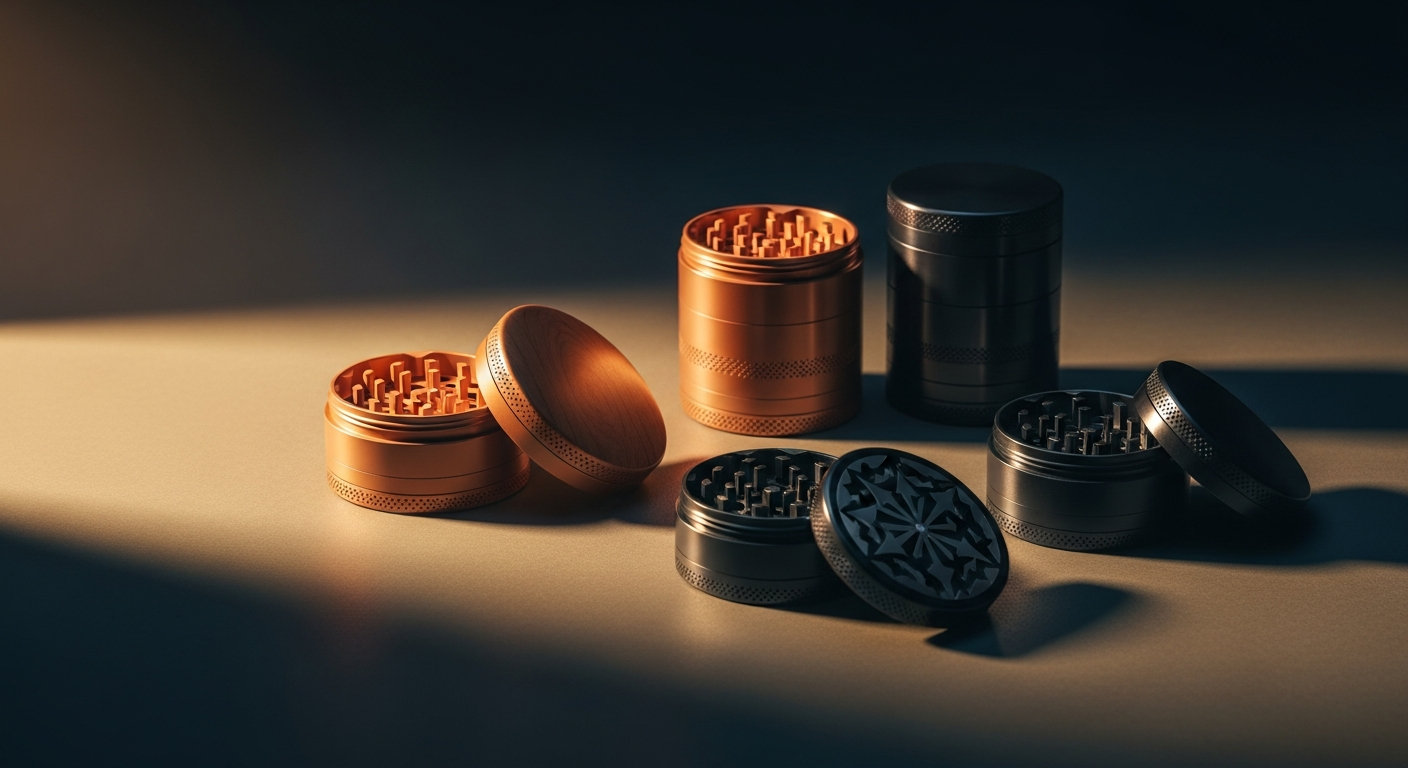
🎯 Key Takeaways
- Tooth geometry matters most: diamond-cut and sharp-edged teeth consistently produce a more uniform grind than blunt, peg-style designs.
- A kief catcher is non-negotiable: any 4-piece grinder without a fine mesh screen leaves usable material on the table.
- Material choice drives longevity: aircraft-grade aluminum and 304 stainless steel outlast acrylic in daily use by years, not months.
- Electric grinders earn a niche role: they excel for high-volume sessions or users with limited hand strength, but manual grinders still dominate for portability and precision.
- Budget doesn't mean bad: the Sharpstone Precision Engineered Dry Herb Grinder at $37.99 punches above its price class with CNC-machined chambers and a reliable screen.


Quick Verdict
The grinder market in 2026 is bigger and noisier than ever, but the fundamentals haven't changed: sharp teeth, tight tolerances, and a reliable kief screen separate the tools worth owning from the ones that end up in a junk drawer. This guide cuts through the noise with five honest picks across every price tier — budget, mid-range, premium, and electric. Whether you're replacing a worn-out acrylic puck or stepping up to a lifetime-warranty mill for the first time, the right grinder is on this list.
Quick Verdict
For most people, the Sharpstone Precision Engineered Dry Herb Grinder at $37.99 is the move — CNC-machined aluminum, a tight 4-piece build, and a 63-micron kief screen at a price that doesn't sting. If you're chasing heirloom-grade quality, the Santa Cruz Shredder or Phoenician Engineering are worth the premium. On a strict budget, a basic 2-piece gets the job done, but you'll miss the kief catch. Scroll down for the full breakdown.
Why a Good Grinder Matters
Consistency is everything. A quality grinder breaks dry herb into a uniform particle size that burns or vaporizes evenly, reducing harshness and wasted material. Cheap acrylic grinders develop micro-scratches over time that trap residue and can shed plastic particles into your herb — a problem CNC-machined aluminum eliminates entirely. A well-designed kief screen also recovers the concentrated trichome powder that sifts off during grinding, giving you a bonus yield from the same amount of herb.
Beyond purity and yield, a good grinder is simply easier to use. Smooth threading, a magnetic lid closure, and sharp teeth that grab herb on the first twist — these aren't luxuries, they're the baseline for a tool you'll use every day. Investing $30–$80 in a quality grinder pays back in a smoother workflow and a screen that actually stays clear longer.
- Uniform grind improves burn or vapor consistency
- Non-toxic materials (aluminum, stainless, titanium) keep your herb clean
- Kief catchers recover usable trichomes that would otherwise be lost
- Tight threading prevents lid pop-off and cross-threading over time
- Sharp tooth geometry reduces wrist strain during grinding
Our Top 5 Picks for 2026
1. Santa Cruz Shredder — Best Overall
Santa Cruz Shredder's medical-grade anodized aluminum and unique fluffy-grind tooth pattern have made it the benchmark for enthusiasts since its debut. The teeth are designed at a specific angle and edge profile that shreds herb without compacting it, so you get an airy, roll-ready consistency. Available in multiple sizes (small, medium, large) and a growing color lineup, it's the grinder most experienced users eventually land on. Expect to pay $50–$75 depending on size — a fair price for a tool that routinely lasts a decade.
2. Sharpstone Precision Engineered Dry Herb Grinder — Best Mid-Range Value
At $37.99, the Sharpstone Precision Engineered Dry Herb Grinder is the easiest recommendation in this guide. CNC-machined from aircraft-grade aluminum, it features a 4-piece design with a 63-micron stainless mesh screen, a strong neodymium magnet lid closure, and diamond-cut teeth that stay sharp through months of daily use. The threading is tighter than you'd expect at this price, and the anodized finish holds up to regular cleaning with isopropyl alcohol. For first-time buyers upgrading from acrylic, this is the obvious step up.
3. SLX 2.0 — Best Non-Stick Coating
SLX introduced a ceramic non-stick coating that was legitimately novel when it launched, and the 2.0 iteration refines it further. Herb doesn't cling to the grinding chamber or screen, which means less frequent cleaning and better kief throughput. The teeth are sharp, the build is aluminum, and the coating is food-grade safe. At around $60–$70, it sits in the same tier as Santa Cruz Shredder but earns its price with the maintenance advantage — especially useful if you grind sticky, resinous herb regularly.
4. Brilliant Cut Grinder — Best for Fine-Grind Control
Brilliant Cut takes a different mechanical approach: a single-chamber shearing design with interchangeable plates that produce fine, medium, or coarse grinds on demand. It's the most versatile grinder on this list for anyone who uses multiple consumption methods — a coarser grind for pipes and bowls, a finer cut for vaporizers. Machined from 6061 aluminum with a proprietary tooth pattern, it's priced at $75–$85. There's no separate kief catcher, which is the main trade-off, but the grind quality and plate system are genuinely best-in-class.
5. Budget 2-Piece Aluminum — Best Entry-Level Pick
If your budget is under $15 and you just need something functional right now, a basic 2-piece aluminum grinder covers the essentials. You won't get a kief chamber, but you'll get a clean, metal grind without plastic contamination. Look for one with sharp, diamond-shaped teeth rather than flat pegs — the difference in effort and output is significant. Pair it with the LA Grinders Premium Kief Press Tool ($4.99) to maximize what you collect from the jar, since you won't have a built-in screen doing that work for you.
Manual vs. Electric Grinders
Manual 4-piece grinders dominate this guide for good reason: they're portable, require no charging, produce a precise grind when built well, and last for years with basic maintenance. Electric grinders, by contrast, are purpose-built for volume and convenience — they shine in high-frequency settings or for users with arthritis or limited hand dexterity who find a manual twist painful over time.
That said, electric grinders are their own category and deserve a dedicated look. For a full breakdown of the top electric models available in 2026 — including one-button operation units and USB-C rechargeable designs — see our Top 5 Electric Grinders deep-dive. The short version: if you're buying your first grinder or want an everyday carry, go manual. If you're grinding for group sessions or managing a physical limitation, electric is worth the investment.
- Manual: portable, no battery, precise, lower cost, long lifespan
- Electric: hands-free, fast, high volume, ideal for accessibility needs
- Manual wins for portability and control at this stage of the market
- Electric wins for convenience in stationary, high-frequency use cases
What to Look For Before You Buy
With dozens of options on the market, it's easy to get lost in specs. Focus on these five criteria and you'll filter out 90% of the mediocre products quickly.
- Material: Aircraft-grade (6061 or 7075) aluminum is the standard. Stainless steel is heavier but equally durable. Avoid acrylic or zinc alloy — both degrade over time.
- Tooth design: Diamond-cut or trapezoidal teeth grip and shred herb more efficiently than peg-style teeth. Look for an aggressive, sharp edge profile in product photos.
- Number of chambers: 4-piece (lid, grinding chamber, herb catch, kief catch) is the practical sweet spot. 2-piece is fine for budget entry. 5-piece adds a second screen tier, useful if kief purity is a priority.
- Screen mesh size: 63–75 microns is the standard range for kief screens. Coarser mesh lets too much plant material through; finer mesh clogs faster.
- Threading quality: Poorly machined threads are the number-one cause of grinder failure. If a product description mentions CNC threading or aerospace tolerances, that's a meaningful spec — not marketing fluff.
Size is a personal call: small (1.5–2 inch diameter) works for solo sessions and pocket carry; medium (2.5 inch) is the everyday standard; large (3+ inch) is for batch grinding. The Sharpstone Precision Engineered model hits the medium sweet spot at $37.99, making it an easy default recommendation while you figure out your preferences.
Side-by-Side Comparison
Use this table to match a grinder to your specific priorities. Prices reflect typical retail in 2026.
📧 Get more honest reviews like this
Our editorial team tests every product we stock. One email per week, subscriber-only discounts included.
Pros & Cons
| ✅ Pros | ⚠️ Cons |
|---|---|
|
|
vs the Competition
| Model | Price | Key Spec | Best For |
|---|---|---|---|
| Santa Cruz Shredder (4-pc Med) | ~$65 | Medical-grade anodized aluminum, fluffy-cut teeth | Best overall daily driver |
| Sharpstone Precision Engineered Dry Herb Grinder | $37.99 | CNC aluminum, 63-micron screen, neodymium magnet | Best mid-range value |
| SLX 2.0 (4-pc Med) | ~$65 | Ceramic non-stick coating, aluminum build | Best for low-maintenance cleaning |
| Brilliant Cut Grinder | ~$80 | Interchangeable grind plates, 6061 aluminum | Best for multi-method versatility |
| LA Grinders Premium Kief Press Tool | $4.99 | Compact kief press, pairs with any grinder | Best budget add-on for kief users |
FAQ
What is the best grinder for dry herb in 2026?
For most users, the Santa Cruz Shredder remains the benchmark for overall quality, but the Sharpstone Precision Engineered Dry Herb Grinder at $37.99 offers nearly comparable performance at a fraction of the price. Your best pick depends on how often you grind and how much you want to spend on a tool you'll use daily.
How often should I clean my grinder?
Plan on a light cleaning — brushing teeth and screen with a dry brush — every 1–2 weeks for daily users. A full isopropyl alcohol soak every 4–6 weeks keeps threading smooth and screen throughput high. Grinders with non-stick coatings like the SLX 2.0 extend that interval considerably.
Is a 2-piece or 4-piece grinder better?
A 4-piece grinder is better for most users because the kief catcher recovers trichome powder that would otherwise be lost. A 2-piece is a fine entry point if budget is tight, but you'll want to upgrade once you see how much material a quality screen catches over time.
What's the difference between aluminum and acrylic grinders?
Aluminum grinders are machined to tighter tolerances, maintain sharper teeth longer, and don't develop the micro-scratches that trap residue in acrylic. Acrylic is cheaper upfront but typically needs replacing within a year of regular use. For anything beyond occasional use, aluminum is worth the small additional cost.
Do I need a separate kief press tool if my grinder has a kief chamber?
Not strictly — but the LA Grinders Premium Kief Press Tool ($4.99) lets you compress collected kief into a puck for easier handling and storage, which many users prefer. It's an inexpensive add-on that makes your existing kief chamber more useful rather than a replacement for it.
🛒 Shop Herb Grinders at Smokerolla →
🔗 Related Briefings
- Best Weed Grinder for Perfect Grind
- The Ultimate Guide to Choosing the Best Smoking Accessories for Your Needs
- Best Pipe Cleaners for Efficient Cleaning
Shop Related Categories
- Herb Grinders - 2, 4 & Multi-Piece
- Smoking Accessories - Grinders, Trays & More
- Best Sellers - Top Rated Smoking Accessories
Disclosure: Smokerolla carries the product reviewed here. Our editorial verdicts are independent.
Share:
Best 510 Thread Batteries Worth Buying in 2026
Best Quartz Bangers Worth Buying in 2026